
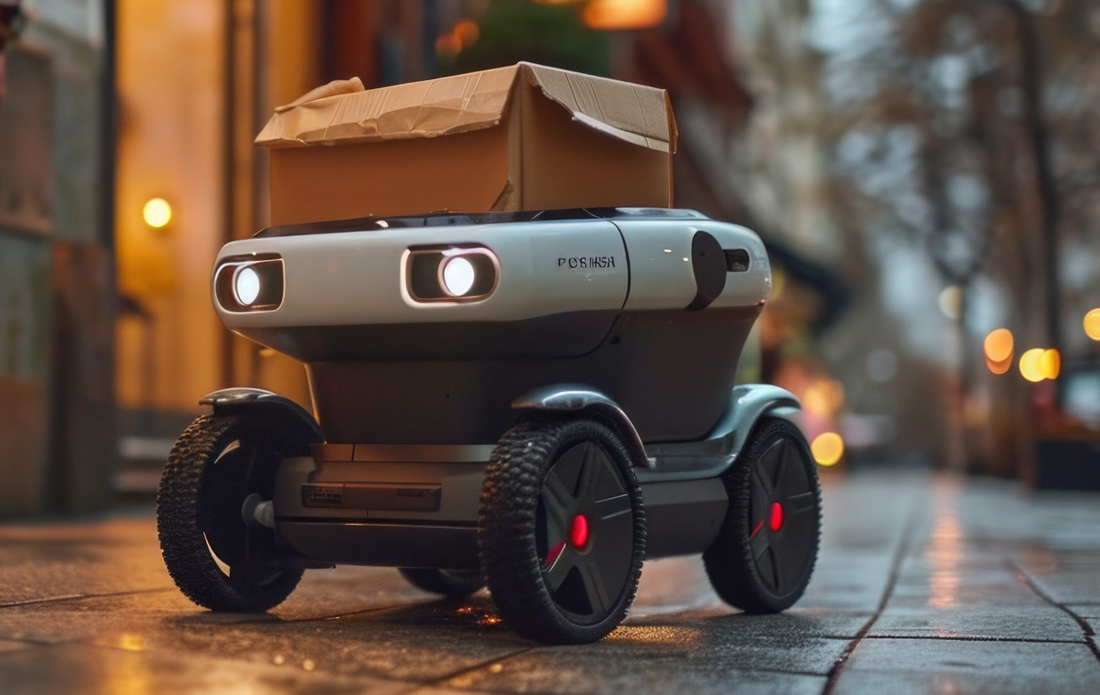
CHECKERS60SIXTY vs COCO!
First published in 2026
Don't like to read? Here is an audio version of this page. This is an AI reader.
Who would win? Man and motorbike with App, or cute little pink robot?
Recently, I spent some time in Chicago. After paying a disgusting 45 USD (about R800!!!) for one bag of washing at Johns Cleaners & Tailoring, and surviving their very rude store manager, I took a walk down the road and found a CoCo. This little pink box on wheels, sporting a cute little flag, immediately grabbed my attention.
So, as soon as I got home, I decided to research it, and here you are now reading the fruits of that! ‘Coco’ robots, cheerfully coloured in pink and orange, are manufactured by Coco Robotics (https://www.cocodelivery.com/).
They are four-wheeled delivery devices designed for short-distance fast food and general grocery deliveries, although I’m certain you could use them for anything that is the size of a baby… not that I am suggesting you use it to transport babies.
Customers can summon a CoCo when selecting robot delivery through popular apps, and then the staff of the restaurant and shop place the desired order inside, lock it, and off the robot goes. It’s powered by batteries and guided by an array of cameras and sensors.
They travel at pedestrian speeds, no faster than a brisk walk, and navigate curbs, trees, and whatever else you might find on a sidewalk with semi-autonomous control. A human operator still monitors the CoCo remotely, stepping in when the machine encounters a complex situation, like an aggressive old man with a stick.
When a delivery arrives, the customer receives a unique PIN to open the hatch and retrieve their goodies! These little robots are concentrated across heavy foot traffic areas, namely River West, West Loop, Fulton Market, and Lincoln Park. Coco Robotics has built partnerships with more than a hundred local restaurants and chains, ferrying meals from familiar names in the USA such as Shake Shack, White Castle, and Harold’s Chicken Shack to doorsteps and office lobbies.
The service, in addition to helping shoppers, is also said to help reduce traffic congestion and lower emissions by shifting short trips from cars to compact, electric devices, and I can see the logic here. Of course the rollout has exposed some cracks in how cities adapt to robotic helpers. Some residents (like those old men with sticks and Karens) have raised concerns about sidewalk congestion, arguing that the machines can overwhelm narrow walkways and become hazards for strollers, pets, and people with disabilities… while this might be possible, I really didn’t see that at all where I was. The cute little robots have also apparently received nasty headlines for their navigation errors, misjudging the odd curb here and there, and many a collision with a bus shelter… but at the end of the day, many journalists would be out of a job if there was nothing to complain about, and frankly, I have seen enough people trip on cat’s eyes to not be too critical, and don’t even get me started on cyclists!
I also wanted to share a little about the innovation team. Coco Robotics, legally Cyan Robotics Inc., began as a Silicon Beach ambition and has since pitched itself as an architect of the city of tomorrow. You have to love big dreams from simple beginnings. Headquartered in Sacramento and backed by more than $80 million (R1.3 billion) in funding, these well-financed innovators have turned their roaming fleet into a neighbourhood-level media network, exploiting the flat, highly visible panels of its machines as moving digital billboards.
Coco operates a physical AI lab where engineers feed the millions of kilometres (or miles) of street-level navigation data generated by the fleet into spatial-computing models. That real-world dataset is the company’s secret sauce: training material for next-generation navigation systems and a bargaining chip in partnerships with larger AI players. Data, remember, is the new gold!
Founded in 2020 by UCLA roommates Zach Rash and Brad Squicciarini with early engineer Shuo Deng, Coco began in modest dorm-room fashion. Its early strategy was deliberately hardware-light: instead of chasing fully autonomous performance from the outset, the company deployed a remotely piloted model. Human operators, nicknamed Coconauts, guided the bots through video game–style interfaces, dramatically reducing engineering and capital costs and accelerating market entry. Between 2021 and 2024, the company expanded rapidly, sustained by early backers that included prominent tech figures. Then, from Santa Monica, it pushed into Los Angeles, Miami, Austin, and even Helsinki, building both fleet scale and data depth. In 2025, Coco closed an $110 million Series B led by SNR with returning participation from notable investors, bringing its active fleet to roughly 1300 delivery robots. By February this year (2026), the firm signalled its next chapter: the launch of Coco 2, a next-generation vehicle equipped with advanced NVIDIA processors and solid-state LiDAR, marking the company’s transition from human-assisted operation to full AI-driven autonomy.
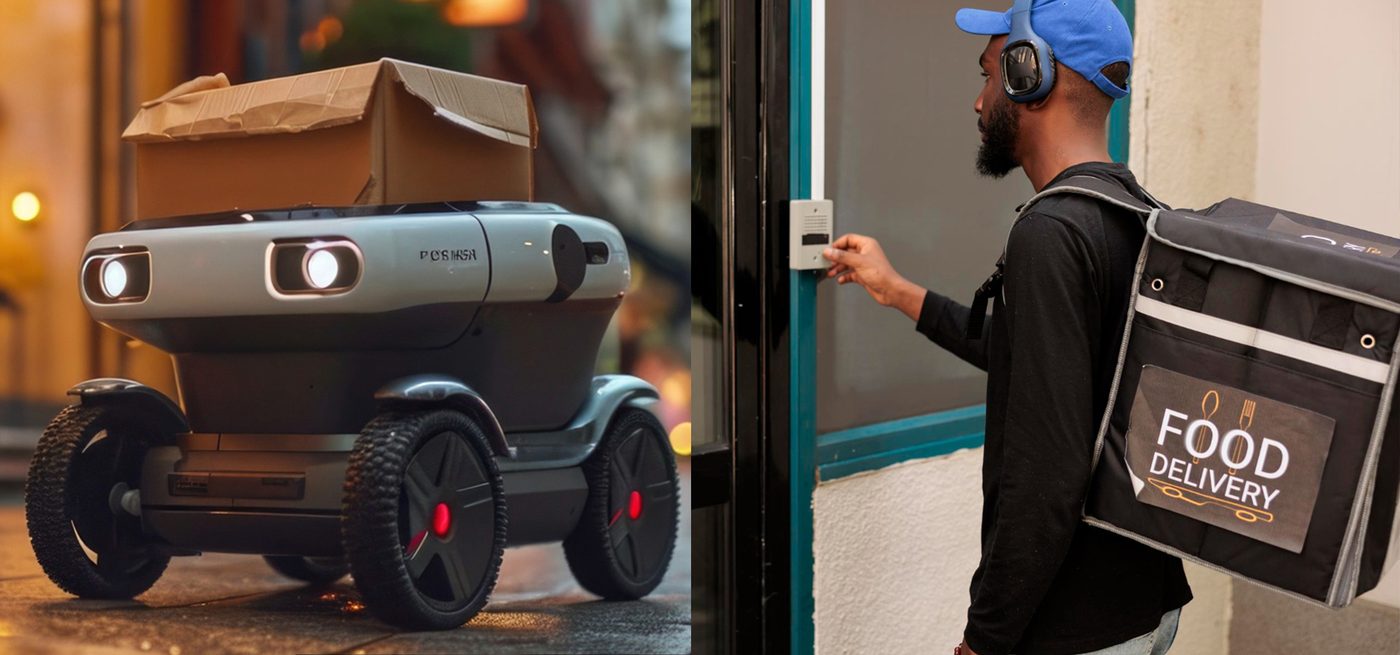
So, what’s next? Cococobanna? Well, I naturally wondered what a sidewalk-robot service like Coco would do to the market if introduced in South Africa. Take a moment to imagine the implications… You might even find yourself giggling at what your imagination comes up with. Our country has an estimated 150,000 to 200,000 platform drivers on scooters and motorcycles filling the demand born out of Covid lockdown, and we now have Sixty60, Mr D Food, and Uber Eats, to name just a few dealing with short-distance trips.
It’s a fact that this e-delivery marketplace now sustains thousands of entry-level and gig workers. Displacing those short urban delivery services with electric sidewalk machines would translate into severe job losses. The transformation would not be a neat swap from riders to robot technicians but a war, and one I do not think CoCo could win, not yet anyway. Instead, I believe a partial adaptation is more likely, starting in areas like Sandton, Rosebank, Stellenbosch CBD, or the V&A Waterfront, where some former riders could pivot to ‘courier-handler’ work, operating hubs where robots deposit payloads before a human completes the final, often complex, handoff. That unresolved ‘first/last 100 meters’ problem, like stairwells, locked intercoms, steep drives, and let’s not forget South Africa’s gated compounds, I mean lifestyle complexes.
For the company that does attempt this transition, they will do so because the human couriers they use contend with steep petrol costs, frequent vehicle issues, and high insurance premiums… and xenophobia.
Battery-powered sidewalk robots promise dramatic reductions in per-delivery costs, potentially lowering fees and reshaping profitability models for operators. Robots have also not yet unionized! These sorts of automated changes and challenges to business models are inevitable, but remember to balance human needs in your equations when you are eventually in the position to either use one of these services or perhaps your business is investigating the implementation of automation. Consider the environment, social buy-in, moral and ethical stands, and who you are trying to compete with.
At least back home, a load of washing only costs R280!
The END.
WANT TO READ MORE ARTICLES?
But wait, there is MORE!
Who is Jean-Pierre Murray-Kline?
Jean-Pierre is a South African serial e-entrepreneur, published author, and change champion who has worked in over 300 types of industries in some capacity or another. His own online businesses have generated millions of Rands and involved sectors such as law, web & app development, events & entertainment, property, technical services, media, and tourism.
He has travelled to over 180 cities worldwide and is extremely active as a business and environmental technologist. In addition to his own projects, he researches and consults on all things online: marketing, reputation, compliance, law, and e-security, and also offers strategy workshops and scenario sessions on future thinking with a key focus on technology, the environment, and global influences.
Jean-Pierre is often asked to be a guest speaker on a variety of subjects he continuously studies and writes about.