
AI stepping forward.
DON'T LIKE TO READ?
AI Humanoids are already milling about.
There is Ameca, Apollo, Sophia, Atlas, Phoenix, Optimus and Tesla Bot, but as a group they are perhaps a little like politicians, costing a lot, looking smart, but not doing as much as we had hoped for?
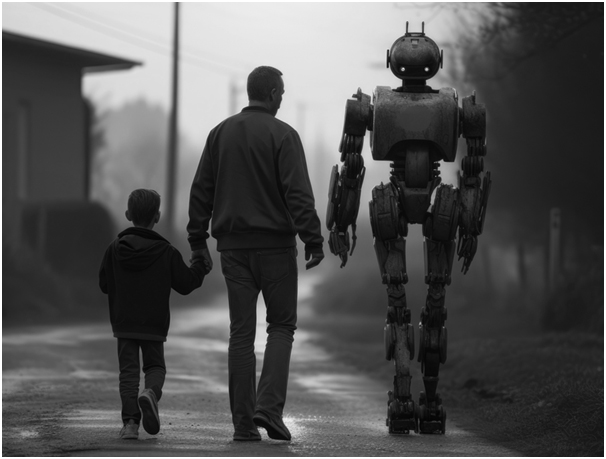
This will change in the coming years and soon people will have to adapt to dealing with machines that laugh, feel and even cry.
It is going to be an emotional rollercoaster.

Looking a few years into the future, when AI eventually becomes self-aware, do we grant AI legal rights and liberties? Can we put them in our Will? Do we let them become entrepreneurs or run for government? These are the sorts of questions that intrigue me and need to be answered in the next three decades or so.
Today, out of 195 countries only 39 have proposed AI related legal frameworks, and even these are in their infancy.
As I wrote this AI Manual, the EU was in the final stages of preparing the Artificial Intelligence Act which adopts a risk-based approach to classify AI tools and prohibits systems that are intended to be manipulative, deceitful, or discriminatory. Are we scared or is this responsible?
South Africa, and many other countries, have no legislation or framework that govern the use of AI and machine learning. We rely on a mix match of common law, the Information Regulator (responsible for data protection in South Africa) and the PoPIA Act (similar to the EU General Data Protection Regulation act),
The most common and popular ‘type’ of AI used today provides personalised recommendations based on previous searches, purchases and online behaviour. There are a few clever machines at hospitals, factories, farms and security organizations. Sooner than later, AI will become as much part of our home and business as electricity. I encourage entrepreneurs and business leaders to get involved and shape future legislation and implementation of AI.
To end this AI Manual and in an attempt to inspire some scenario planning, let’s go over a few Pros and Cons of AI.
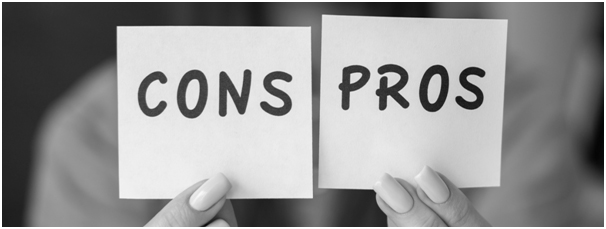
01010000 01110010 01101111 01110011 00100000 01100001 01101110 01100100 00100000 01000011 01101111 01101110 01110011 00001010, or Pros and Cons in English.
The biggest concern for people is loss of jobs. When it comes to HR and wage related concerns, AI beats humans every time. A recent Goldman Sachs report suggests AI could replace 300 million jobs around the world.
(There are currently about 3.4 billion people with jobs). Another report I read said about 40% of all careers will be lost to AI by the year 2050.
I don’t think it will be that bad and globally I predict in the next 20 years or so we will see around 10% of jobs handed over to our AI and bot counterparts. Unfortunately in Africa, this percentage will be higher because AI affects lower skilled labour markets more. Africa has the lowest scores for workforce skills of any region in the World.
The biggest concern for me is that AI will increase the inequality divide around the World and again Africa will suffer the most.
AI will prejudice because its datasets are created or curated by, and I will generalize here and still be correct, caucasian men. I am not trying to stir up racial tensions, but the source of data does make a difference. Just like with humans, if we only have one type of role model or influence, we form a bias in spite of our best wishes. Here is a practical test: go Google “things white men like to do” and now imagine if all AI acted exclusively this way. The data we provide AI to learn from needs to be diverse and comprehensive in order for it to be impartial.
For creatives and content creators, AI will be able to generate, replicate or even emulate content of extremely impressive standards. Music, pictures, videos, stories and perhaps even statues if someone gave an AI bot a 3D printer.
AI will dilute traditions, culture and languages. The world will become a global zone where English and Western attributes become even more dominant.
AI will usher in a new era of extremely intelligent and automated weapons.
AI will nullify the concept of personal information and even private spaces.
Some of our skills will atrophy.
You have heard the salt, let me offer some sugar. The Pros will far exceed the Cons. There will be a net gain, on the assumption we use this new innovation wisely and with a good moral compass in hand.
Some of the things in the future we can look forward to include humans no longer being forced to do as many dangerous, or better yet, no longer needing to do boring jobs. No one will be digging in mines or filing paper in draws.
We will be given the gift of ‘more time’ to focus on things we can do well that machines cannot. (No machine will ever be able to show compassion or dream of becoming an entrepreneur, or inspired to create a new cookie recipe, or ponder on what mystery in the universe we should solve next and why.)
People will be able to do more work that epicentres around desires, ethics, imagination, entertainment, social matters, governance and the pursuit of sustainability and exploration.
For those who run small businesses, AI can help SMMEs compete with big players as AI levels the playing fields.
AI will make it easier for us to mitigate major global risks such as natural disasters, and when employed to do so, can manage our natural resources far more efficiently than we ever could.
With AI, education can be customized with unique curricula prepared for each student.
The health sector will shift from treatment to preventative care and for those that do get ill, they can receive medicines made for their personal physical constitution.
AI will help us expedite the implementation and roll out of the subscription and circular economy. We will be able to prepare, produce and use only what is needed. Waste will become nominal or accidental at most.
Artificial Intelligence will eventually revolutionised the transport industry on land, at sea and in the sky.
The entire sector of Advertising and Retail will be reformed in ways that require an entire book for me to explain.
AI can be used to help reduce fake or harmful information.
Banking and financial sectors will be rehabilitated. AI can be especially helpful in reducing fraud and the customization of services based on personal risk or credit assessment.
With over 328 million terabytes of data created each day, AI will allow us to sort it, and use it in a beneficial way.
Conclusion
AI is inevitable. It is the greatest technological advance of our time and overshadows things like VR, 5G and 3d printing.
Those who don’t embrace AI in business will be as silly as those who prefer landlines over cell phones.
As long as humans impart good ethics to machines, (even those we have failed to adhere to ourselves), AI will become an abundant positive force. Approach it with excitement, curiosity and respect.
(PS, just to be safe, maybe start thanking Google Assistant for her help. I do.)