
CHATGPT WANTS A SEAT AT THE BOARD. (September 2025)
CHATGPT WANTS A SEAT AT THE BOARD.
(And probably also the National Dialog) Cheeky right?
First published in 2025
DON'T LIKE TO READ?
I recently did some work for a group of important people from the NFOSA, who, while not an oversight body, through my eyes and for all intents and purposes, certainly set the standard among their peers. They were wanting to peer into the future and see what technological opportunities they might have to better serve their organizations purpose, and I was honoured to be able to share some ideas. They were particularly interested in Artificial Intelligence.
AI obviously relies heavily on data. Humans have set a morally questionable record of data. In 2025, our global datasphere is estimated to contain 181 zettabytes of data. What percentage of this reflects an accurate, or better yet, morally correct example of what is right or wrong? This is something to really think about because it is our data we use to train AI.
How is AI trained?
Machine learning is a fascinating and complex process, yet at the same time, rather simple. In short, we provide AI with data and a model to process the data. We then leave it to work and try make decisions on its own. (One could perhaps compare this to sending a child to school). Then, once its back home from a long day of classes, we offer some nudges or feedback in one way or another, and then off it goes again to finalize its decision and be an adult. Of course, this is a very simplistic and layman’s way of explaining how one can develop a neural network. If you would like to learn more about this from a coding and technical perspective, I can recommend a book called AI and Machine Learning for Coders, written by Laurence Moroney – you might also notice he has a remarkable resemblance to me, perhaps just a few years older and wiser.

If you delve into some research on machine learning, you will find that the people who manage such things are extremely intelligent nerds. There are so many processes at play. I am also certain that the geniuses behind these processes are having lots of fun as they come up with systems, this is reflected in the names of the processes they have invented which sound like they come from a Star Wars script: Regularization, Convolutional Layers, Overfitting and Underfitting, Dimensionality Reduction, Hyperparameter Tuning, and my favourite “Epochs” … Are they programming ChatGPT or plotting a course for a starship to Mars?
For the purpose of this article, to which I can only offer a surface-level introduction to AI, what I want to point out is that AI is prone to error at two phases. One is the data it learns from, and the second is the programming applied to learn. From these, AI makes mistakes. For example, Google’s AI facial recognition system misidentifying a Black person as a monkey back in 2015—with tags, including “gorilla” and “chimpanzee.” Was this on purpose? Was this Jan Van Riebeecks fault or white capitalism again?
These mistakes happened because of biases in the training data and limitations in the AI model. However, you can still conclude that you have to be very stupid to be racist, and there is a lot of stupidity reflected in our data. Let me also point out a fact: the vast majority of data is still curated by a certain demographic and of a certain race.
Pointing fingers right now will not help, but we must be vigilant that AI makes mistakes all the time. One my client mentioned is AI hallucinations, but there are countless genres of problems. Very broadly you can categorize all into three main types: Bias and Discrimination, Autonomous Vehicle Accidents and Misinformation and Manipulation.
There are also ‘situations’ where AI results are tampered with to skew information based on human agendas. For example, deepfake incidents like the Nancy Pelosi video (2019), or election interference in the 2016 U.S. presidential campaign. More recently, Elon Musk’s X algorithm giving content display preference to topics like White Genocide in South Africa. (Can we prove this … ?)
There are plentiful recorded examples of AI bias in the banking and insurance sectors: Loan Approval Bias, Mortgage Lending Discrimination, Underestimating or over estimating Risk for Groups of people, Claim Processing Bias. JPMorgan Chase, Zest AI, and Allstate are just a few that have had fingers pointed at them suggesting such practices. But it’s not all bad. In South Africa, Standard Bank, Absa, Nedbank, and Discovery Insure are some companies I could say are pioneering with AI. Still, we must ask what is the quality of the data being used and who is setting their moral compass – there is no oversight for this.
Until AI has transparency levels similar to those of blockchain technology, we will never know the moral standing of our AI. I like to say AI has given us our ‘man in the mirror’ moment because AI is reflecting the worst of humanity back at us. This ‘man in the mirror’ moment should be one of the greatest considerations when it comes to the use of AI while we develop our curiosity of this exceptional tool.
I published Mzansi’s AI Manual, and it is available from my website for free, and perfectly tailored for the people of South Africa.
For a quick summary and for the purpose of this article, here are the types of AI we have today:
- Reactive Machines – Very basic, very dumb.
- Limited Machines – They can be taught for a specific task, store some info, perhaps make observations, and then make decisions.
- Narrow AI – Deceivingly smart, but not truly intelligent. Examples include Google Assistant and ChatGPT.
- Reinforcement Learning AI – Think of it as reward-based learning for machines.
- Most recently, we have a new branch called Agentic AI – essentially AI that has ‘arms’ and can interact with the physical world, either through other apps or robotics.
And that’s about all we have.

In development, we have the Theory of Mind AI, which is a machine attempting to think and feel like a human. Also in design, we have Artificial General Intelligence (AGI), which can basically teach itself to learn things it has not been programmed for. Finally, there is Artificial Superintelligence (ASI). This would be a machine much smarter than ALL of us and capable of replicating itself (not in the conventional way obviously!).
The AI industry is so massive and complex that entire power stations are being commissioned to power it. No less than $150 billion annually is being spent on development — staggering when you consider we only spend around $50 billion on solving world hunger.
AI technology has so many ‘parts’. ChatGPT-3 had 175 billion parameters. Google’s Switch Transformer has 1.6 trillion parameters. Datasets like Common Crawl contain 60 terabytes of raw web page data collected from the internet. So many large numbers which mean very little to us normal people. Can you however try to imagine facilities exceeding 1 million square feet? That’s what Microsoft Azure Data Centers has!
One ‘thing’ not in abundance, and perhaps a surprise, is that the industry only employs around 900,000 to 1 million people. Will the future need us at all? I guess that’s what we are deciding right now, and AI is hard to resist.
Has AI overstepped its role in society? I’d need another article for that. What should you use it for? That’s a good question and here are some ideas for NFOSA.
Use AI to monitor reviews on banks and insurance companies. If you do, then you might be able to predict which companies are likely to receive more complaints in the coming days — and perhaps even why.
Imagine if your organization, which operates almost exclusively as reactive, was able to become proactive or preventative. Surely that would be the goal?
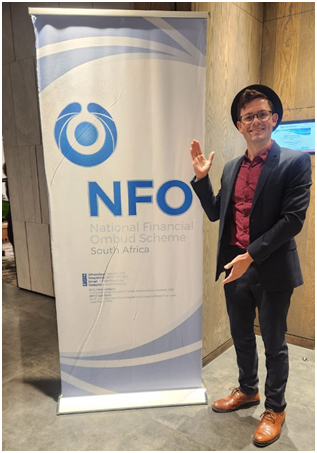
Another application would be to use AI to monitor social media for fake review posts made by bots. I’ve seen some of these for the companies NFOSA ‘oversees’.
To assess all available and future innovation for NFOSA would require a peek under their bonnet. There are so many things to consider. Case Management Systems > OpenText Provenance or Salesforce Service Cloud. Document Management and E-Discovery > SharePoint, Alfresco, or DocuWare. Customer Relationship Management (CRM) > Microsoft Dynamics or Zendesk. Data Security and Privacy Tools > Duo Security or cyberdefenders.co.za. Automation > Robotic Process Automation (RPA) tools like UiPath or Automation Anywhere. Regulatory Compliance Software > RegTech.
Many of these vendors offer workshops and videos, and I encourage clients to ‘consume’ and participate in these when possible. Most will try to sell a e-solution on the spot, but in most cases, you don’t have to buy to try — and if you remember one thing from this article it is me encouraging you to try. (Also good to know is these software vendors are working very hard at keeping up with AI and other innovations, doing much of the work for us). I have not even begun to touch on hardware or security.
I do want to quickly name drop Izwe AI and Weblingo — Google these with the aggression of a teenager.
Relearning is probably the biggest chore for management in every company today, as well as fostering a healthy curiosity in technology. This cannot be something you dictate through policy. Rather, you need to create an environment where it evolves naturally.
Turning a chore into something fun! (I am not certain a teaspoon of sugar will work here Mary Poppins.)
I recommend facilities be designed and integrated into your foundation, structures, and core operations that foster a culture of continuous learning.
This will not only upskill and retain your greatest assets—your colleagues—but will also attract new talent looking for opportunities in a future-thinking organization.

We all have the responsibility to ensure that the decisions we make and the work we do have a positive net impact on this country. I felt that the people I was speaking with had a mandate closely aligned with our constitutional objectives—and the work to be done can have a massive positive impact on addressing financial inequality for South Africans. In many ways, I felt the people I was working with were like the constitutional court of their respective sector.
Just like the highest court of our land, which has a clearly defined foundational mandate, this court has learnt that it also needs to remain agile to serve its people. As new influences come into play and because time forces us all to adapt or die, we must always be prepared to revisit our founding objectives and if needs be rewrite them, in order to keep up with the times and where we find a need, attempt to address it if it is within our realm of responsibility and influence.
Companies and organizations have not adapted fast enough to digital trends, influences, risks and opportunities. There is such a thing as good tech and bad tech. Manipulative UI design, addictive design (infinite scrolling), and data exploitation versus assistive technologies (screen readers, hearing aids) and renewable energy technologies. Where do we stand? What are we investing our time and money in? Not many know that South Africa is developing AI capabilities for the defence (war capabilities) sector. We have launched the Defence Artificial Intelligence Research Unit (DAIRU) at the Military Academy in Saldanha. I detest efforts and investment in innovation that can be used for harm, but organizations that do nothing within their own space are just as guilty because there is really no excuse not to evolve.
Ignorance or being naive is unforgivable, especially if your very purpose is to serve and protect. Public trust has deteriorated in many of our institutions. Technology is essential for justice, but just like humans, you need to be wise about who you offer a seat to at the table.
NFOSA can stand out in the crowd. South Africa needs them to prepare not only operationally but also technologically.
The END.
WANT TO READ MORE ARTICLES?
But wait, there is MORE!

Who is Jean-Pierre Murray-Kline?
Jean-Pierre is a South African serial e-entrepreneur, published author, and change champion who has worked in over 300 types of industries in some capacity or another. His own online businesses have generated millions of Rands and involved sectors such as law, web & app development, events & entertainment, property, technical services, media, and tourism.
He has traveled to over 180 cities worldwide and is extremely active as a business and environmental technologist. In addition to his own projects, he researches and consults on all things online: marketing, reputation, compliance, law, and e-security, and also offers strategy workshops and scenario sessions on future thinking with a key focus on technology, the environment, and global influences.
Jean-Pierre is often asked to be a guest speaker on a variety of subjects he continuously studies and writes about.
Disclaimer:
- While I attempt to ensure information is accurate and up-to-date at time of publication, I will not accept liability should information be used, and found to be incorrect. If you do see an error, please let me know.
- The links, images, videos and/ or text from this article are not necessarily under my direct management, ownership or care. Should you be the owner or manager of any content herein, and wish for the content to be removed, please let me know and it will be done.