
MILLING ABOUT IN THE FUTURE (April 2025)
The Challenge of Change is Action –
The future of the Milling industry in South Africa.
DON'T LIKE TO READ?
First published in 2025
I research a number of sectors and their trajectory. Recently, I got to work on the ‘Milling Industry.’ It was a unique experience because it’s not too often I get to share an overall ‘good outlook’ for a sector. I am no miller, farmer, or anything even vaguely related (and you could tell this in a heartbeat if you met me in person), but I don’t need to be an expert in my client’s industry to do my particular job. I need to look at a client’s operation from an impartial and abstract position, and in fact, in order to do my job well, I need to know a little about many things and be a master of none.
This is not to say I don’t get my hands dirty and spend a great deal of time studying and doing research for my clients. Authenticity is also very important for me and lends itself to the credibility of my work. I visited Goderich Flour Mills, spent the day walking about (or milling about, please excuse the pun), met the owner, shared stories, and looked at actual working equipment.
So now that my prelude is done, what can I share with you about an industry that has been around for thousands of years?
I will start with a question: “Will there come a time in South Africa where we supplement raw materials for 3D printing solutions, like the printing of grain?”
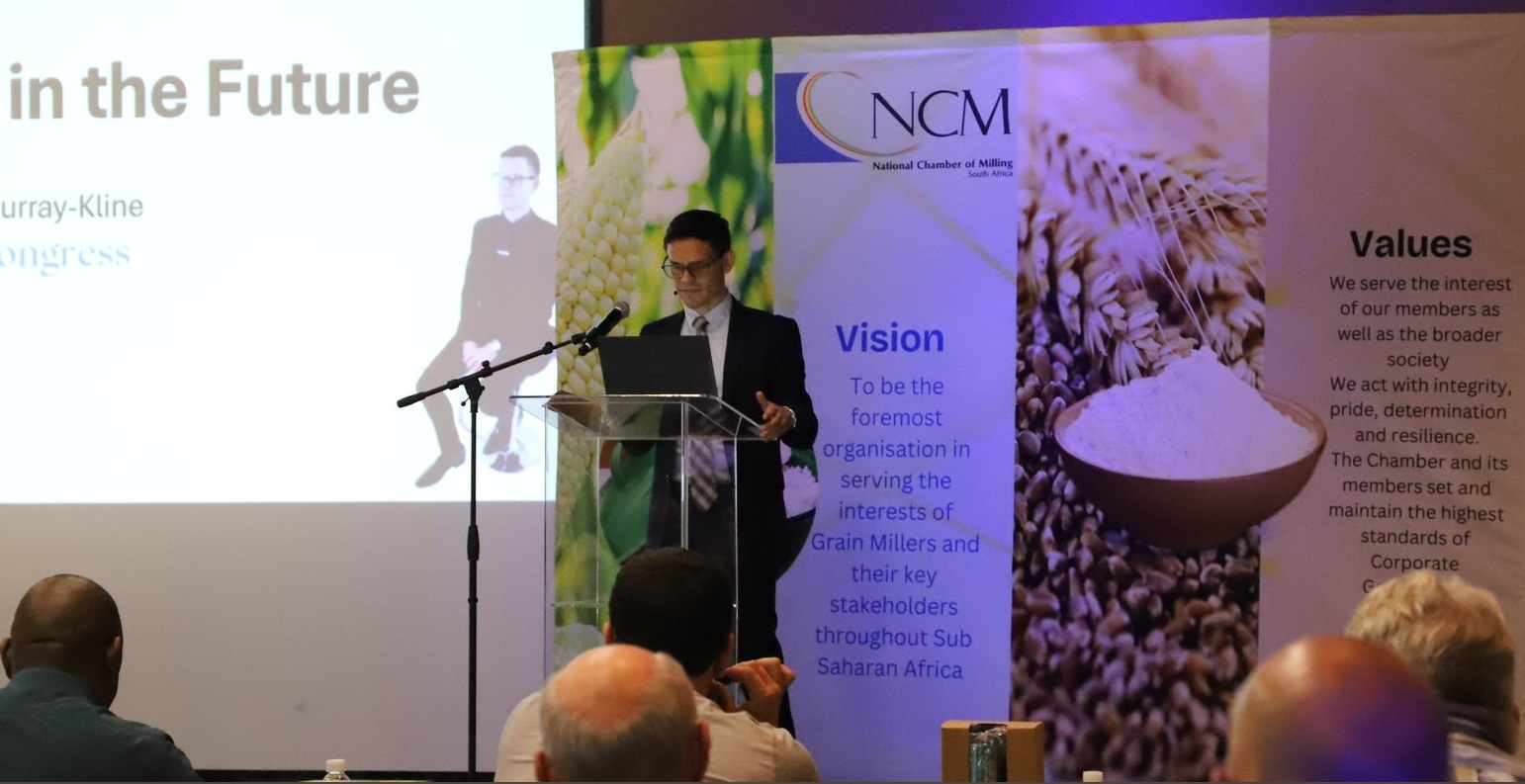
I heard an outright no to this question when I asked it to a room full of people at the Milling Industries National AGM.
The technology I had in mind when asking this question is already theorized, with several practical tests being done using genetic engineering, selective breeding, and tissue culture, which could, as a collaborative effort, result in a superior raw product, which, mind-blowingly, would require no farmers at all, no large fields, far less water, and could be produced at the mill. Technically possible? Yes. Will this ever happen? No, not in the near foreseeable future.
But we must not forget the pace of change. An example I like to give is that it only took 66 years between the first powered flight from land to air and the next step, the Moon landing! 66 years! The two biggest drivers of change for the milling sector are, in no particular order:
- attracting future employees
- our farmers
Just like banks have had to become technology companies, mills need to be acutely aware of these two drivers of change, and wherever possible, engage and become change champions to influence these onto a more favourable path. The milling industry needs to adapt to ensure that part of its business model includes education, youth engagement, and collaborations with the broader farming industry.
In 15-50 years’ time, our continent will have a lion’s share of people under the age of 25; in fact, most will be between 18 and 21. It will, for all intents and purposes, be the ‘youngest continent’ in the world. Africa is the continent primed for success. Not only do we have more fertile land than any other continent, but we also have more minerals needed for future technologies than any other in the world.
Africa should not have to rely on the USA or the European Union. To the contrary, Africa is the future solution for the rest of the world, and I am unfortunately a minority who believes this in just about every room I walk into.
But the USA knows it, Europe and Asia know it. The only people who don’t believe it are Africans. We must change this narrative, especially in an effort to set a better example for the youth.
Gen Z is as intelligent as a Starlink satellite and as money- and success-hungry as that company’s owner. Generation Alpha and Generation Beta are yet to be factored in, and they come next, and I don’t think they are going to be any easier for businesses.

There really is a lot to think about regarding how the milling industry attracts and guides the youth. I am aware of the training programs and the role of mentors in the sector. I am also aware of the good work being done ‘with the end products,’ like flour, and, for example, the baking programs by Supreme Flour. Unfortunately, this good work will not be enough to ensure the sector can replace the retiring workforce and attract a future one. What to do?
The sector needs to get its businesses online, not forgetting the metaverse, VR, AR, MR, and whatever comes after that. Mills need to open their doors to tours and offer tactile experiences. While it is impractical to drag an entire classroom of children around an operating mill, one can create mock factory rooms. I know this will cost a few Rands, but please remember the first career you fell in love with? Do you remember what you were exposed to that made you fall in love with your dream career? If the sector wants to solve its future employment challenges, it must do more to attract the youth, and exposing them to a real mill is the trick!
Run competitions for high schools and universities, asking scholars to invent new technologies for real industry concerns. Africans are exceptional innovators.
Champion full bursary and funding models. Our students suffer tremendous student debt and are also pressured into pursuing careers that, at the end of the day, might not be the best option for them.
Many mills employ family members in their management structures, and while this is perfectly fine, it can sometimes limit the doors of opportunity for outsiders. I believe that in 2025, it is becoming harder to keep family businesses exclusively family-owned, which might be a good thing. Do not forget the privilege ability the industry has in using business to transform a sector that is poorly represented by Black people in management positions.
Let’s move on to farmers. They have many of their own problems:
• fertilizers,
• soils,
• pests,
• and many more.
They face issues with water, electricity, infrastructure, rail, ports, and unions, and our farmers are getting older!
Farmers and millers are equally affected by global pressures and influences such as geopolitical politics and policies. If our farmers do badly, so will our mills. The same can be said for technical infrastructure suppliers supporting the milling industry. It baffles my mind that equipment found within the mills is almost exclusively from overseas, leaving our local entrepreneurs missing an opportunity.
AgriApp, FarmSpace, and MoMee are great apps to inspire ideas. Technology can provide an open-source solution for communication and problem-solving if someone just launches it for the sector.
There is an insurance company in South Africa that does not like to wear clothes, but they recently raised $38 million in a Series B round to automate and expand their product offerings.
Let’s look at the bigger picture now. There are two influences that affect every human: climate change and cybersecurity or e-threats. As the Milling sector embraces equipment for Industry 4.0, they are also putting themselves at risk of e-crimes. Precision and stock management systems can all be hacked and held for ransom. Damages from e-crimes for businesses this year are expected to rise to $10.5 trillion.
Freak weather, floods, and droughts have been the reasons for many closures of businesses over the millennia. Global warming is one of the worst-told stories ever. Most people zone out and will not listen. We must accept that in 2025, it’s no longer about stopping global warming; it’s about mitigating the catastrophic effects that will unravel until global temperatures and our ecosystems settle and reach their new norm. The people who live through this period, certainly the children of most of the people reading this article, are not going to be prepared for the negative ramifications: extreme damage to homes and businesses. Lives will be lost. A point I am certain you will all agree with is that infrastructure in South Africa will not weather a bad storm.
Think about the 3.1 million+ hectares of land we use; will this be shrinking or increasing? The crops most at risk from climate change, in order of greatest severity to least, and I hope you all know this by now, are wheat, maize, rice, soybeans, potatoes, coffee, and cocoa. With seasonal creep, will maize still come from Gauteng and Mpumalanga? Wheat from the Western Cape and Northern Cape, and rice from Mpumalanga and KwaZulu-Natal?
There are several other influences I could touch on in this article: legislative changes (I have identified 7 regulations or acts at play), the supermarket revolution, investment and financing changes, demographic trends and urbanization, dietary trends, and future foods. Unfortunately, this article has far exceeded the recommended Google word count already! So, let’s try to conclude.
Technology has come a very long way since the first milling machine invented by Eli Whitney, but have we reached our peak potential yet?
Roller mills: are they as efficient in their grinding methods as possible, and do high-pressure grinding rolls really signify the peak of our innovation here? Hammer mills: can we improve control over particle size and energy use? Sifters and separators: can laser-based sorting systems really improve efficiency and accuracy? Mixers: can these become fully automated and also include real-time, effortless monitoring? Packaging machines: will we use robots to do it all?
No matter what we look at within the business, be it grain cleaners or phone apps, one thing is clear to me: the robot-to-human ratio is shifting. There will be a percentage-wise reduction in human tasks compared to automated tasks.
I understand that in South Africa, the maize and wheat milling industries collectively employ approximately 12,000 people. What are the safest jobs?
• Research and Development (R&D) Specialists,
• Food Safety and Quality Assurance Managers,
• Maintenance Technicians, especially robotics and automation experts
• Logistics and Supply Chain Managers,
• That person in the office, no matter what their position is, but the one that holds a Union Rep title,
• Sales and Marketing Professionals,
• Training and Development Coordinators,
• Data Analysts/Scientists (yes, future mills will need these),
• Environmental and Sustainability Managers—every mill should have someone covering this.

If you work in the industry and your job title is not on this list, it’s time to diversify! What is most important for me to point out is that there are no ground staff portfolios on this list.
What about the actual number of milling businesses that house all these workers? I understand there are about 300 registered maize mills and approximately 40 wheat mills in South Africa. I believe this number will grow, and the added numbers will come from smaller mills because it’s inevitable we will see improved supply chains and delivery methods, as well as more compact equipment with less storage needs. Literally, operations can be smaller and cost less to set up. What else do I think is likely to see significant change in the next 15 years or so?
- Raw Material Sourcing,
- Quality Control Laboratories,
- Advanced Milling Equipment,
- Artificial Intelligence (AI) and Machine Learning,
- Online Platforms and E-commerce.
Change is often hard to picture when it comes to an article format, so let me end with a story called “MILLING ABOUT IN THE FUTURE.”
In the heart of the Western Cape, set against the backdrop of soaring mountains and sun-drenched vineyards, is a mill named “Franco Mostert’s Mill” (inspired by a rugby player). It was a marvel of modern technology and a beacon of sustainability in South African agriculture, but not dissimilar to other mills around the continent. Surprisingly, it had lots of people milling about, in spite of some person named JP who predicted far fewer people.
You see, by the year 2040, the once-traditional milling operation had transformed into a digital powerhouse, integrating advanced technology with age-old practices passed down through generations and also on Facebook. The entire business had amalgamated with the infrastructure and environment around it.
Inside the mill, drones zipped overhead, delivering coffee and chocolate to employees, of which there were many—employees, not drones.
At the helm of Franco Mostert’s Mill were Nkonki and Marko, lovers and a perfect mixture of business partners with a keen entrepreneurial spirit. They had won the mill in a gambling game with a very old mill owner who had a gambling problem.
The mill operated on solar power, harnessing abundant light, while a biogas generator processed organic waste from local farms and the mill itself.
Every Thursday, the facilities were open to school tours, and they had a mock bakery and mill factory just for the students. In the far north corner of the plot, there was a permanent research and development building used by local universities. Nkonki also set up a cottage there for her mom.
On Fridays, bio-waste was collected by the City of Cape Town; some was sent to other farms to feed animals, and the rest went to a recycling center, which then paid back carbon credits to Nkonki and Marko, who used these funds to pay for bursaries. (Carbon footprint and carbon allocation were major factors for all industries to consider by the year 2040 and started back in 2027.)
As Nkonki and Marko sat outside and watched the bustling activity from their balcony, they felt proud. This was good business and a business that did good. People from around the world could view, via live streaming video, the day-to-day operations of the mill, which attracted internships and youth.
Through collaborations, they had expanded their product offering far beyond a slice of bread and now offered corn-based snacks, gluten-free flour products, and maize protein powder for those gyming at Virgin Active. It was also very popular for those working in parliament and at SAPS (who, in the year 2040, were required by a new law to maintain their fitness and abandon the “stomach out, chest in” approach).
Nkonki and Marko also produced sweeteners, biofuels, and a very unique new fabric for future clothing.
The challenge of change was no challenge at all once people identified both opportunities and influences and injected some ‘will’ to move into the future.
Milling had become a sector that improved revenue while balancing technological innovation without compromising the human element.
The END.
WANT TO READ MORE ARTICLES?
But wait, there is MORE!

Who is Jean-Pierre Murray-Kline?
Jean-Pierre is a South African serial e-entrepreneur, published author, and change champion who has worked in over 300 types of industries in some capacity or another. His own online businesses have generated millions of Rands and involved sectors such as law, web & app development, events & entertainment, property, technical services, media, and tourism.
He has traveled to over 180 cities worldwide and is extremely active as a business and environmental technologist. In addition to his own projects, he researches and consults on all things online: marketing, reputation, compliance, law, and e-security, and also offers strategy workshops and scenario sessions on future thinking with a key focus on technology, the environment, and global influences.
Jean-Pierre is often asked to be a guest speaker on a variety of subjects he continuously studies and writes about.
Disclaimer:
- While I attempt to ensure information is accurate and up-to-date at time of publication, I will not accept liability should information be used, and found to be incorrect. If you do see an error, please let me know.
- The links, images, videos and/ or text from this article are not necessarily under my direct management, ownership or care. Should you be the owner or manager of any content herein, and wish for the content to be removed, please let me know and it will be done.