
NUGGET (30 AUGUST 2024)

Nuggets! (Bite size updates on the real important stuff related to Tech, Trends, Business and the Planet.)
Imagine growing your own home? Interesting concept? (By the way, I am not talking about living in a tree either!) NASA is currently working on a solution for growing habitats. You can read all about it here, or just take a peek at my summary that follows: https://www.nasa.gov/news-release/nasa-advances-research-to-grow-habitats-in-space-from-fungi/
My summary:
Wonderful NASA is developing an innovative approach to constructing habitats for lunar and Mars missions using fungi-based materials. This is part of their Mycotecture Off Planet project, which aims to create sustainable and compact habitats that can be grown on-site. The project, which recently secured $2 million through NASA’s Innovative Advanced Concepts (NIAC) program, involves the use of mycelium—the underground threads of fungi—alongside materials like yard waste and wood chips. The project is spearheaded by Lynn Rothschild at NASA Ames Research Center. This concept involves sending lightweight, compact habitats containing dormant fungi, which can be activated to grow, forming a functional habitat upon arrival. This really is groundbreaking technology; it not only promises to transform space construction by reducing mass and resource use but also aims to integrate additional features, such as radiation protection.
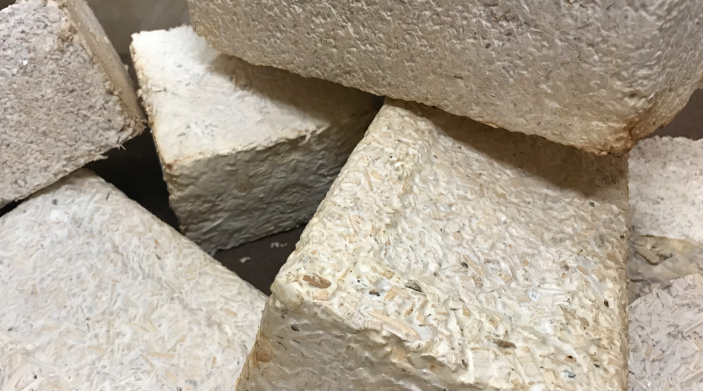
Bricks produced using mycelium, yard waste and wood chips as a part of the myco-architecture project. Similar materials could be used to build habitats on the Moon or Mars.
Credits: NASA.
NASA’s investment in the mycotecture project is a part of its broader objective to push the boundaries of human exploration into deep space, aligning with the upcoming Artemis missions to the Moon and potential future missions to Mars. The research under the Phase III NIAC award will focus on optimizing the material properties and preparing for real-world testing in low Earth orbit. Very exciting! The project’s team has already demonstrated the viability of fungal-based materials through prototypes tested in planetary simulators. These materials also offer Earth-based applications, such as water filtration and mineral extraction. All very good stuff!
~
Water from air! (I am not talking about clouds.) Water harvesting from the atmosphere is not a new concept. This article is a positive update on the concept and very interesting. I really wish that innovation didn’t so often have a link to warfare. Nonetheless, it’s still very good science! https://www.sciencedaily.com/releases/2024/07/240723182005.htm
~
Some 3D printing news!
This time… Artificial Blood Vessels for us? Some very clever researchers at the University of Edinburgh have created innovative 3D-printed vascular grafts that could transform heart bypass surgeries! These gel-like tubes, produced through advanced 3D printing and #electrospinning technology, mimic the strength and flexibility of human veins while reducing risks such as scarring, pain, and infection associated with traditional vein removal. Their future research plans include testing grafts in animals and eventually moving onto human trials. The research, in collaboration with Heriot-Watt University, represents a significant advancement in vascular tissue engineering, potentially offering better treatment options for cardiovascular diseases. I love it when technology is used for good! Read more here: https://www.ed.ac.uk/news/2024/artificial-blood-vessels-could-improve-heart-bypas
~
What is a Smart City? It is a city that uses innovation and technology to be more efficient. Here is a prime example of such a city in South Africa.
Imagine being stuck in space! This very idea gives me the heebie-jeebies. In the coming years, we will hear both good and bad news about our space adventures. There will also be a lot of ‘drama’ about individuals and even companies involved in our endeavors. We must remember that the objectives of space exploration are much larger than us all. We must push on! Here is an article about some unfortunate people who got a little stuck in space: https://futurism.com/the-byte/retired-astronaut-boeing-starliner
~
Not all ‘humans’ made it. There used to be ‘more’ types of us. Here is an update and article on our ‘smaller’ cousin, nicknamed Hobbits. On a separate but related note, I want to share my opinion that with our ability to travel (and therefore breed with others so far away), humanity’s diversity in terms of overall ‘look’ will, in the years that follow, amalgamate, and the harsher differences we fight about nowadays, like skin colour, will be less obvious. It’s an era of cultural and physical incorporation. Will there be white and black people in the far future? I don’t think so, and if so, it will be very rare.
https://futurism.com/the-byte/new-evidence-ancient-hobbits/
Just in case you didn’t know, South Africa has a Department of Science and Innovation. They have a budget of R10.5 billion Rand. Here is some news from the Budget Vote for 2024/25, which took place recently. Want to know what might be done with that moola? Perhaps read the full article here: https://www.news-medical.net/news/20240726/Cellular-competition-determines-X-chromosome-usage-in-female-bodies.aspx
~
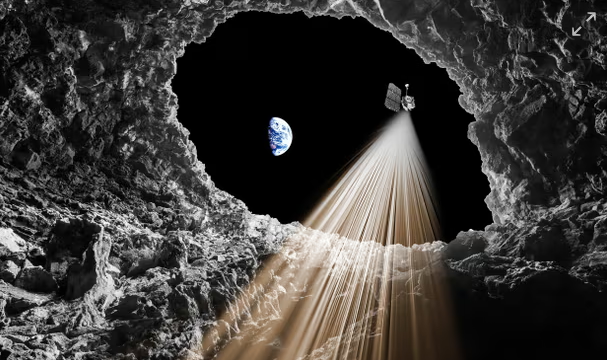
Credits: NASA.
Some researchers have discovered an underground cave situated in the Mare Tranquillitatis (Sea of Tranquility) region on the moon, accessible from a deep pit only.
This cave, equivalent to about 14 tennis courts in size, lies about 150 meters beneath the lunar surface and could potentially serve as a natural shelter for future lunar explorers due to its protection against the very harsh lunar environment.
The evidence from radar data collected by NASA’s Lunar Reconnaissance Orbiter (or LRO for short) suggests that the cave may be an empty lava tube, offering a stable temperature and shielding astronauts from cosmic rays, solar radiation, and micrometeorites.
The same researchers, utilizing LRO data and computer simulations, found that the cave extends for tens of meters westwards from the 100-meter-wide pit and could offer valuable insights into the moon’s formation and volcanic history. There is potential access to water ice, meaning these underground structures may be crucial for long-term lunar missions and colonization efforts. Of course, there are challenges regarding assessing the structural stability of these caves, questions on how to reinforce their walls, and developing monitoring systems for potential hazards like movement or seismic activity. (The moon obviously does not have earthquakes! It can experience moonquakes, which are believed to be caused by the gravitational forces between the Earth and the moon.)
You can read a more detailed article here if you like: https://www.theguardian.com/science/article/2024/jul/15/underground-cave-found-on-moon-could-be-ideal-base-for-explorers
PS: In the not too distant future, some lucky people will be able to, relatively easily, get a job on the moon!
~
What is a Carbon Credit, and how did the City of Cape Town make 36 million rand from it?
This is something we need to know and really should want to know. Basically, a carbon credit is a ‘certificate’ that permits the holder to release a specific quantity of carbon dioxide or other greenhouse gases. Generally, one carbon credit is equivalent to the right to emit one metric ton of carbon dioxide or its equivalent in other gases. This idea is part of a global market-driven strategy for managing pollution by offering financial incentives for emission reductions.
Entities such as organizations and countries that lower their emissions below a set threshold can sell their surplus credits to those who need them, thus providing a monetary incentive to curb greenhouse gas emissions. This framework is frequently linked to global agreements like the Kyoto Protocol and efforts to tackle climate change. In the future, most businesses are going to have regulations which control our carbon impact. You might want to get in on this sooner rather than later. The City of Cape Town just sold theirs for 36 million! Read more here: https://www.engineeringnews.co.za/article/cape-town-nets-r36m-in-carbon-credit-auction-2024-07-17
The End!
HUNGRY FOR MORE NUGGETS?
But wait, there is MORE!

Who is Jean-Pierre Murray-Kline?
Jean-Pierre is a South African serial e-entrepreneur, published author, and change champion who has worked in over 300 types of industries in some capacity or another. His own online businesses have generated millions of Rands and involved sectors such as law, web & app development, events & entertainment, property, technical services, media, and tourism.
He has traveled to over 180 cities worldwide and is extremely active as a business and environmental technologist. In addition to his own projects, he researches and consults on all things online: marketing, reputation, compliance, law, and e-security, and also offers strategy workshops and scenario sessions on future thinking with a key focus on technology, the environment, and global influences.
Jean-Pierre is often asked to be a guest speaker on a variety of subjects he continuously studies and writes about.
Disclaimer:
- While I attempt to ensure information is accurate and up-to-date at time of publication, I will not accept liability should information be used, and found to be incorrect. If you do see an error, please let me know.
- The links, images, videos and/ or text from this article are not necessarily under my direct management, ownership or care. Should you be the owner or manager of any content herein, and wish for the content to be removed, please let me know and it will be done.