
WHAT IS R50 TO YOU? (First published February 2024)
WHAT IS R50 TO YOU?
DON'T LIKE TO READ?
Recently I worked on subject material regarding domestic cleaners in South Africa and from this I shared the following social media post:
- “Domestic Workers in South Africa, are in many ways, modern and legalized slave labour.
- There are around 900 000 people working in this sector.
- Even at the increased minimum monthly salary of R4 433.60 a month, this is still simply not enough.
Offer R400-R500 a day, or clean your own home or office. Failing so, you are enabling and supporting a really bad economic environment and try to employ South Africans.”
You can find this post on my timeline on the 15th of January 2024. At the time I prepared this article the post had 20 000 views, 1100 engagements and 130 comments on ‘X’.

For a domestic cleaner, the minimum wage for 8 hours work in South Africa is a pathetic R210, give or take a Rand or two. This is law, and a law made by people who earn an enormous amount more, with the average annual salary for a middle-level public manager between R779 435 and R947 802. This works out to an average of R430 per hour, which means the people who created this law earn nearly double the minimum daily wage in one hour of their day.
As for the rest of us, the average salary in South Africa ranges between R312 000 and R3 756 000 per year, so depending on what side of the scale you sit, we earn roughly R154 and R1 800 per hour, basically between 6 and 72 times more than the minimum wage of a domestic cleaner for the day.
I have shared this comparison on earnings to demonstrate the ‘pay gap’. I am not going to debate if what you earn is reasonable because I know many of you have lots of experience, certificates and work really hard. I do want you to imagine earning around R350 a day (this is the actual average pay a domestic cleaner is paid for the day) and trying to feed, house, medicate and transport yourself and complete an educational course to try to better your job prospects.
Onto the point of this article, my title was “What is R50 to you?” Let me expand this line of questioning and ask: “can R50 buy respect or dignity?”, “would R50 be the difference between your good or bad behaviour?”
This article is about online social media behaviour (with special focus on those anonymous social media accounts). I want to use how some people responded to what at the end of the day works out to me asking for about R50 more a day for domestic cleaners, as an example of bad online behaviour. Most unpleasant and fake content on the web is made by anonymous profiles. When we come across contributors without a face or name we should scrutinize their content before taking it to heart, and think twice before ever re-sharing something they post.
Anonymous profiles allow people to share whatever they wish without real world ramifications. For now (at least) the internet and social media remain an e-environment for bullies, opportunists, scoundrels, predators, cyber criminals and people who appear to suffer from coprolalia, or an inability to refrain from threats and perfectly fine with spewing out disingenuous comments. If you come across e-scoundrels, and the platform you are using allows you to report or block a user, do it!
I want to encourage everyone that we behave online in a way that uplifts the standards and quality of the overall web experience and be brave enough to call scoundrels to order.
My social media post was not a subject to be flippant about. There are 900 000 people who work as domestic cleaners in South Africa, and taking into consideration that there are about 15 million people employed, it means that roughly 1 in 20 people with jobs in this country clean someone’s home or office. That is a huge percentage of our workforce and influences the overall economy. The entire sector is a red flag, it is unhealthy, unequal and an indicator of a failed society and economy. In the USA a cleaner can earn R320 per hour and in the United Kingdom R230 per hour. It is a luxury, and those who have the service are prepared to pay for it.
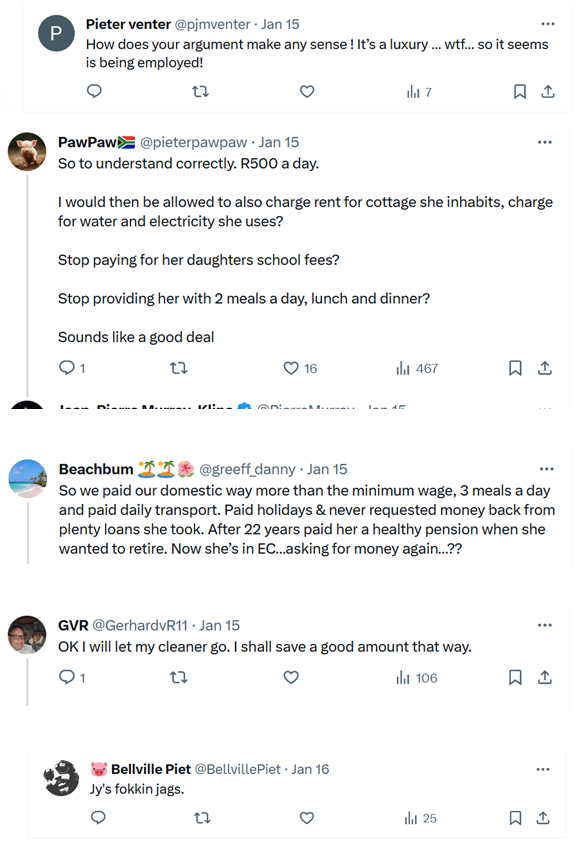
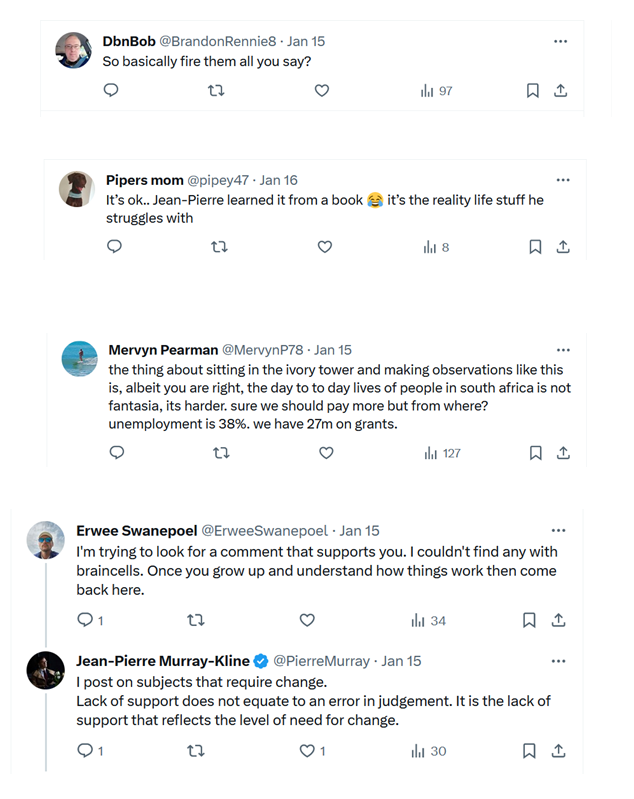
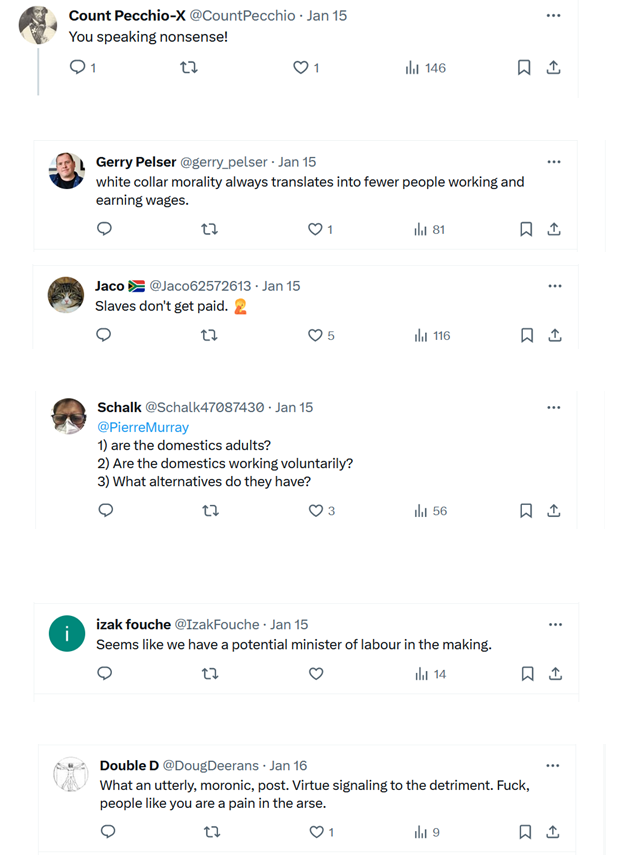
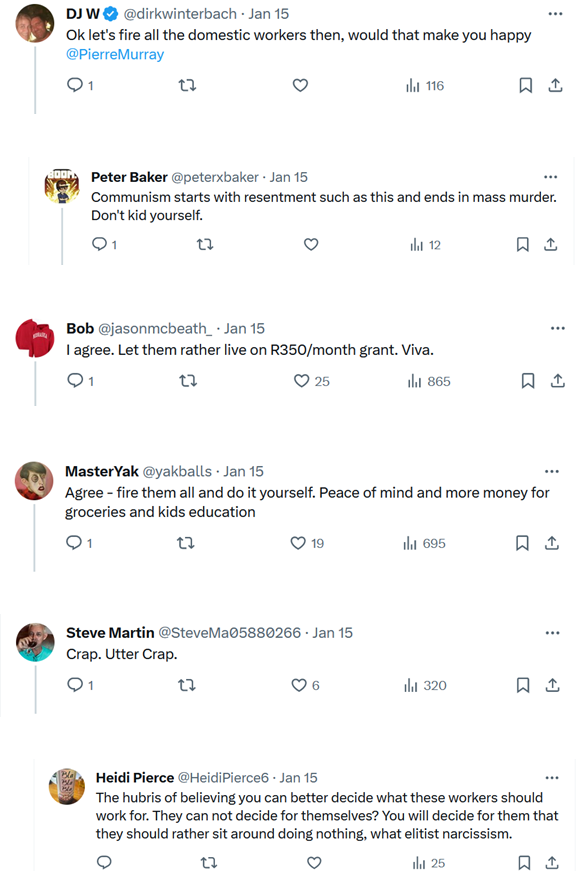
Included are some examples of responses to my social media post that show a tone that would never be accepted in a real-life situation. We have a complex problem for both employer and employee to tackle, but the employer is in a position of power and why I made a plea to them to take the lead. Incremental steps in the right direction get us to the destination.
Let me address the insinuation that those who are employing domestic workers are slave owners because some people on my thread felt this was my point. Although if you actually read the post it is very clear I was drawing a comparison only. I referred to the appalling pay for this sector as ‘modern and legalized slave labour’ and started with “…are in many ways”. Wages are regulated by law, but law is a reflection of a society’s moral status. Law does not always mean justice. Many laws have changed and are no longer acceptable.
The fact is that the remuneration offered to domestic cleaners is so awful, I can reference slavery because the pay barely covers the most basic of needs for a human, never mind an employed one. By any moral definition, we cannot really call them employed because they are stuck in a system, they are slave to it. Let me take the comparison further. Slaves in some instances were offered rudimentary food and basic housing. Some domestic cleaners receive similar ‘antidotes’. Slaves were subjected to requests which were often demeaning, beyond reason, and subjected to verbal and even physical abuse. These ‘things’ happen to domestic cleaners in 2024 here in South Africa.
People who sold and bought slaves many years back believed it was a reasonable trade and the ‘stock’ once employed by them had reached their potential. It is common that the ‘employer’ has the belief they are helping these ‘unfortunate people’ whom without ‘their’ intervention would be far worse off, and that I have to imagine would be the mentality of a ‘slave owner’.
With the above said, I know some people who have employed domestic cleaners have gone far and beyond what is required by an employer, certainly by law, but let me be clear that this is rare.
Unfortunately the internet is a breeding spot for ignorance and short-sightedness. The scoundrels who commented on my post would change their tone if they were at the CCMA, labour court or even a public space that would strip them of their anonymity. What we do online should reflect what we do in real life, our actions must have real-life consequences.
Let’s behave better online.

THE END.
WANT TO READ MORE ARTICLES?
But wait, there is MORE!

Who is Jean-Pierre Murray-Kline?
Jean-Pierre is a South African serial e-entrepreneur, published author, and change champion who has worked in over 300 types of industries in some capacity or another. His own online businesses have generated millions of Rands and involved sectors such as law, web & app development, events & entertainment, property, technical services, media, and tourism.
He has traveled to over 180 cities worldwide and is extremely active as a business and environmental technologist. In addition to his own projects, he researches and consults on all things online: marketing, reputation, compliance, law, and e-security, and also offers strategy workshops and scenario sessions on future thinking with a key focus on technology, the environment, and global influences.
Jean-Pierre is often asked to be a guest speaker on a variety of subjects he continuously studies and writes about.
Disclaimer:
- While I attempt to ensure information is accurate and up-to-date at time of publication, I will not accept liability should information be used, and found to be incorrect. If you do see an error, please let me know.
- The links, images, videos and/ or text from this article are not necessarily under my direct management, ownership or care. Should you be the owner or manager of any content herein, and wish for the content to be removed, please let me know and it will be done.